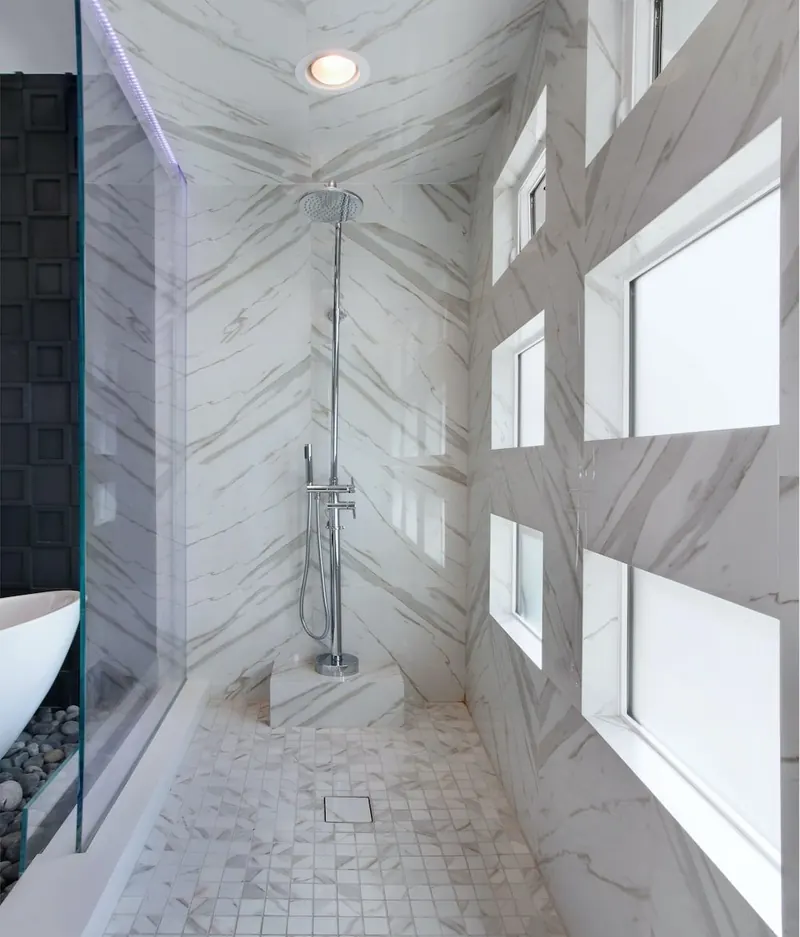
Tile with Style handles walk-in shower installation in Greenville, SC and across the Upstate: custom tiled showers, tub-to-shower conversions, curbless entries, niches and benches. Every shower goes over a sloped pan and a waterproofing membrane installed to the manufacturer’s specification. We are licensed, insured and family-owned, and the estimate is free and in writing.
Since 2011
15 years in Greenville
Family-owned
The owner is on every job
Licensed & insured
In South Carolina
Free estimates
Written, no obligation
What does a walk-in shower installation include?
A walk-in shower installation covers everything from the old shower coming out to the new one being sealed: demolition, framing and subfloor repair, a sloped and waterproofed pan, waterproofed walls, tile layout, setting, grout and sealing.
Demolition and haul-away of the old shower or tub surround
Framing and subfloor checked; rot and flex are fixed before anything gets covered
Shower pan built to the correct slope, with the drain set to the finished tile height
Waterproofing membrane on the pan and walls, installed to manufacturer spec
Dry layout of the tile, so cuts land where they look planned and not at eye level
Setting, grout and sealing, with silicone at every change of plane
Niches, benches and curbs built into the waterproofing, not stuck on after
Curbed or curbless: which walk-in shower fits your bathroom?
A curbed walk-in shower has a low step at the entry that keeps water in; it works in almost any bathroom. A curbless shower has no step at all, so the slope has to be built into the subfloor itself, and that decision has to be made before demolition starts.
Curbless is the easiest shower to walk into and the easiest to keep clean, which is why people planning to stay in their home for the long run ask for it. It is also the least forgiving: if the floor is not recessed and sloped correctly, water ends up on the bathroom floor. We check the joists and the floor structure before we tell you whether curbless is realistic in your bathroom.
Tub to shower conversion: what comes out and what goes in
In a tub to shower conversion the bathtub, the wall surround and usually the drain come out. What goes back in is a complete shower: a new pan sloped to the drain, waterproofed walls, and tile from the floor up.
A tub is its own water barrier, so taking it out means building the waterproofing from scratch. The drain almost always sits in the wrong place for a shower, and the valve height changes too. If a quote for a conversion does not mention the drain, ask why. The other choice people weigh is an acrylic liner system, which goes in fast. A tile conversion takes longer, but you choose the size, the layout, the niche and the entry, and you can repair it one tile at a time instead of replacing the whole unit.
What goes under a walk-in shower?
Under the tile of a walk-in shower there is a waterproofing membrane, a pan sloped toward the drain, the drain body, and a subfloor stiff enough not to flex. The tile you see is the wear surface. The layers underneath are what keep the water out of your framing.
Most shower failures we open up are failures in those hidden layers: a pan with no slope, a membrane that stops short of the curb, or tile set straight onto drywall. Our shower waterproofing page covers how we build each layer.
What does a walk-in shower cost?
The price of a walk-in shower depends on four things: the size of the shower, whether the drain and valve have to move, the tile you choose, and what we find behind the old walls. That last one is the reason nobody can give you an honest number over the phone.
Size and layout: a standard 60-inch alcove is a different job from a large primary-bath shower
Plumbing moves: relocating the drain or the valve adds labor and a plumber’s visit
Tile format: large-format and natural stone need a flatter wall and more setting time
Hidden damage: rot or a failed old pan is repaired before the new shower is built
How long does it take to tile a shower?
A standard shower takes most of a week from demolition to final grout. Setting the tile is only part of it. The waterproofing and the mortar both need cure time, and rushing either one is a common reason a new shower fails early.
You get a start date and a list of the days we will be in the house. If something turns up once the old shower is out, we stop and show it to you, with photos and options, before we go on.
Who does the work
Written by the team at Tile with Style, a family-owned, licensed and insured tile installation business working in Greenville, SC since 2011. Work is carried out by Javier Rincón and his crew.
Updated:
How the job runs
From first call to final walkthrough.
01
Free Estimate
We come to your home, measure the shower, look at the substrate and leave you a written estimate.
02
Tile & Layout
We help you choose tile that suits your shower’s size, and plan the layout so the cuts fall where they should.
03
Demo & Waterproofing
Old shower out, framing and subfloor checked and repaired, pan sloped, membrane installed to spec.
04
Tile, Grout & Walkthrough
Setting, grout, sealing and silicone. Then we walk the finished shower with you before we leave.
Shower Tile Installation · FAQ
Questions we get on every job
You can, if you are comfortable with demolition, plumbing, pan slope and a waterproofing system installed exactly to spec. The tiling is the part people expect to be hard. The waterproofing is the part that actually decides whether the shower leaks, and a mistake there stays hidden until it shows up as damage below.
Water escaping past the opening, water pooling because the pan has too little slope, grout cracking at the corners, and leaks at the curb where the waterproofing was not wrapped all the way over. Almost all of them trace back to the pan and the membrane, not to the tile.
In a primary bathroom it usually is: a walk-in shower is easier to use and makes better use of the space. If it is the only tub in the house, think about who will live there later, since some buyers with young children look for one.
We do not recommend it, and in most cases we will not do it. New tile over an old shower buries whatever is failing underneath, usually the pan or missing waterproofing. It looks finished on day one and fails anyway, and the second repair costs more than doing it right the first time.
Small mosaic, typically two inches or smaller. The extra grout lines give you grip and the small pieces follow the slope toward the drain. Large tile on a shower floor either has to be cut into wedges or it fights the slope.
Yes, and we build them into the waterproofing rather than adding them afterward. A niche is a hole in a waterproofed wall, so it has to be sealed as part of the same system and sloped slightly so water runs out of it.
Serving Greenville, SC and the Upstate within 60 miles: Simpsonville, Five Forks, Mauldin, Greer, Taylors, Travelers Rest, Fountain Inn, Easley, Spartanburg and Lake Keowee.